Thomas Bodley spearheaded plans for the Bodleian’s first Benefactor’s Register. Its magnificent decoration would go on to cause a headache for him and his first librarian, Thomas James.
The history of the Bodleian is well-known and often-told, so this won’t be the place for an in-detail recollection. However, it’s important to build context and set the scene for what was to come after the library’s foundation in 1602.
The university hosted a library as early as the early 14th century in the University Church of St Mary the Virgin, though this was replaced in the late 15th century by Duke Humfrey’s Library. Situated above the newly-built Divinity School, this new institution was made possible thanks to a significant donation of almost 300 manuscripts by Humfrey, Duke of Gloucester. Unfortunately, this collection was removed by Richard Cox, Dean of Christ Church, in 1550, leaving the university without a purpose-built library for the first time in over two centuries1.
Head-stop of Humfrey Plantagenet, Duke of Gloucester (1930–1447), one of the heads of historical figures placed either side of doorways in the Old Schools Quadrangle, Oxford.
Enter Thomas Bodley. After a career as a diplomat in the service of Elizabeth I during the 1580s and 1590s2, Bodley returned to England from continental Europe and dedicated himself to the establishment of a new library, to replace that “which then in every part lay ruined and waste”3. With significant material resources at his disposal (thanks to his marriage to Ann Carew, the widow of wealthy fish merchant Nicholas Ball) combined with extensive political connections, profiency in multiple languages, and a scholarly background4, Bodley set about his task.
Portrait of Sir Thomas Bodley (1545–1613), painted in the 1590s by an unknown artist. Held by the Bodleian under shelfmark LP 71.
Beddard gives a good account of the sequence of events that led to the library’s revitalisation under Bodley’s behest. In early 1598 he wrote to George Abbot, then Master of University College and later Vice-Chanceller of the University of Oxford, offering to refurnish Duke Humfrey’s Library with not only furniture but a collection of books5. By mid-1600, after handling the expense of having to replace the rotten timber frameworks of the neglected old library building, the renovation was finished6.
Bodley wasted no time in advancing to the next step of his plan, needing “to stirre up other men’s benevolence”7 in order to gather the books on which to found a library worthy of the university. He called in favours from all of his friends: “lords, knights, and officials of the Court of […] Elizabeth I,”8 by all accounts this list could be considered a Who’s Who of early 17th-century England! The plan was a huge success. The donations poured in, and by 1604 Bodley was officially declared the founder of the new library9.
MS. Wood F. 27, copies of documents concerning the university and city of Oxford. Fols. 43–44 (fol. 43r pictured) are Bodley’s copy of James I’s letters patent recognising Bodley as the founder of the new library: “ex fundatione Thome Bodley, militis, in Universitate Oxon” (line 21).
Early ambitions and challenges
As Adams and Ferlier explain, the flow of donations posed challenges. In its first years the library was receiving all manner of curiosities extending well beyond the realm of books and including taxidermised animals and complex scientific equipment. Bodley felt the need to apply discretion to what the library could take on, founded on a hybrid of the basis of user need and his own devotion to Protestant ideals10. He wrote to his librarian, Thomas James (see below) expressing this desire, which could be considered something of a proto-Collection Development Policy for an academic library!
Fol. 25v of MS. Bodl. 699, a collection of letters written by Thomas Bodley to his librarian, Thomas James. This page shows the second half of a 1601 letter written by Bodley to James, in which he concludes by expressing that “My hope was and is that the greatest part of our Protestant writers will be given” (line 22)11.
As evidence of his commitment to ensuring the success of the project, throughout the course of their working relationship at the library, Bodley “micromanaged” James’ duties, with his correspondence full of instruction and critique for his librarian12. One of James’ greatest challenges, was that of keeping track of the thousands of donations being received by the library in the early 1600s. Evidence of this effort survives in the form of objects such as Library Records e. 273 and 274, volumes 1 and 2 of the Bodleian’s ‘Autograph Catalogue’ (an alphabetised record of all held objects).
Fol. 7r of Library Records e. 273, vol. I of the Autograph Catalogue of the Bodleian, 1613, written by Thomas James.
One of the first significant fruits of these efforts was the 1605 printed catalogue of the Bodleian Library13. Bodley’s ambition was for this to fulfil several needs. To assist in the book-buying process, to better serve library users (who up to this point “had been directed to handwritten ‘tables’; sheets pinned up at the end of each press describing the arrangements of books”)14 and “to advertise the library’s great success to critics and potential donors alike.”15
Such was the catalogue’s importance that Bodley placed exacting demands on James create a work of the highest standard. He did not mince words when he was not satisfied, as can be seen in the letter below:
Fol. 169v of MS. Bodl. 699. In this letter dated October 26, 1604, Bodley writes that “…the very first impression, that men shall have had upon the sight of your Catalogue, will be that it shall give credit or discredit to the Library” (line 24). The letter is addressed to his “special and good friend Mr Thomas James” (see fol. 170v) so we can at least assume it was nothing personal!
While Bodley clearly had his criticisms, the first catalogue was a remarkable achievement, representing one of the first examples of a record of an academic library’s holdings in the Western world16, and was a testament to the remarkable success Bodley had enjoyed in accuring donations to his new institution.
Suffering from success
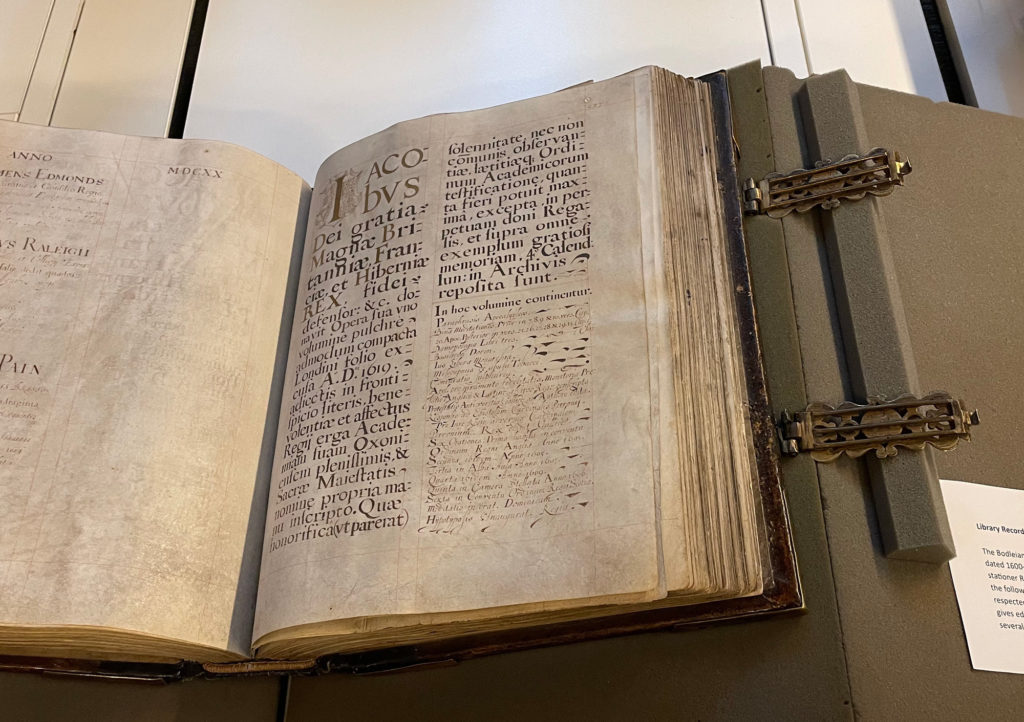
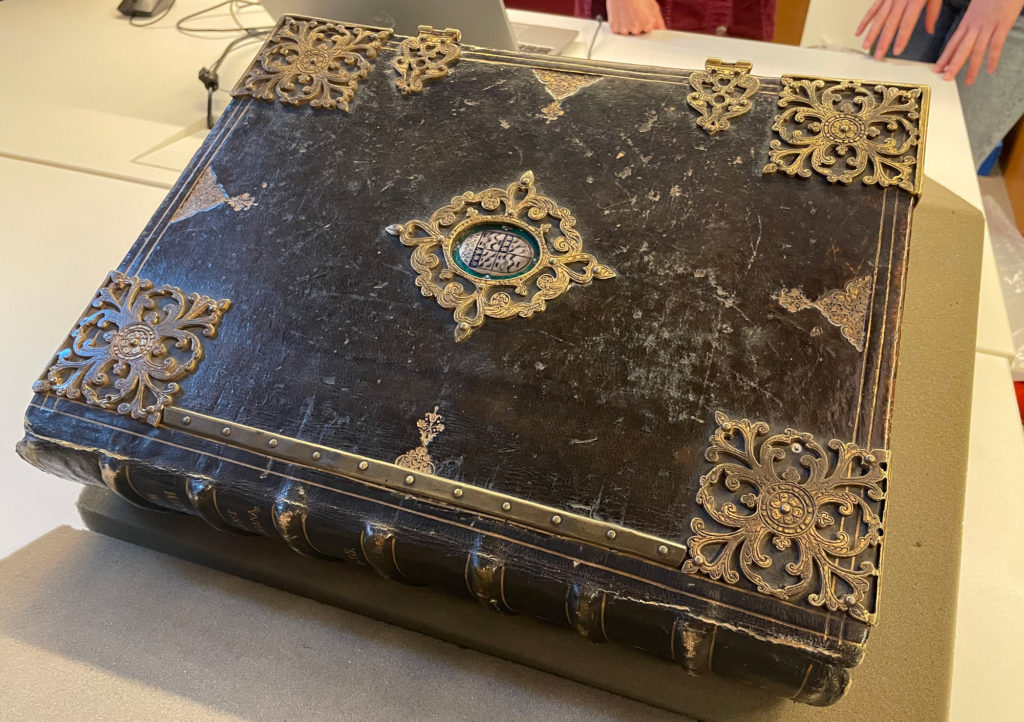
Another promotional initiative of Bodley was the creation of the Benefactor’s Register. The register is a large printed volume, “with historiated initials commencing each donation and several of the higher profile donors’ coats of arms illuminated and gilded.”17 In print until 1604, it was Bodley’s aim for every donation to be immortalised in this grand volume regardless of its size or value, likely as a carrot to be dangled in view of any would-be donors.
I had the opportunity to see the register in person during a Bodleian staff coffee morning in mid-January 2024, where Anna-Lujz Gilbert, Ben Wilkinson-Turnbull and Rahel Fronda spoke about their research relating to the Shaping Scholarship: Early Donations to the Bodleian Library project. I took the opportunity to snap a couple of pictures:
Bodley’s pledge for every donation to receive equal billing only went so far however, and it seems to be the case that the sheer volume of donations received by the library caused the reality to dawn that elaborate acknowledgement of every single donation would be an impractical undertaking. On June 9, 1602, Bodley wrote to James:
It is a very poore gifte, which yow signifie of Mr Tailour, and likewise that of Mr Hawthorne, which are well worthie thankes, as any booke of any sort, but vnles they be bettered, we may not fille vp the Register with such benefactours.18
Fol. 55r of MS. Bodl. 699 shows Bodley’s letter of June 9, 1602 to his librarian Thomas James. The quoted text begins at line 17.
In a following letter on June 18 of the same year Bodley clarified to James those remarks:
I would intreat yow to signifie in curteous maner, to suche as giue but a booke or two, as Mr Hawthorne and some others, that they may not expect for a couple of litle bookes in 8o. [octavo] to be recorded on the Register. For so I should fill it as full of mens names almost as of bookes : but they must ether better their giftes, or be contented, to haue only their names written on the bookes, as bestowed on the publ. Librarie.19
Faced with this embarrassment of riches, Bodley’s solution was to create a more nuanced form of acknowledgement based on the size of the donor’s gift20. After the print form of the Benefactor’s Register in 1604, the decision was made for future registers to simply be composed in manuscript and modestly bound, as shown below, thus bringing a close to a short-lived yet spectacular tradition.
The modest Library Records d. 423, the Bodleian’s Register of Donations for 1692–1710, stands in stark contrast to its predecessor.
Thomas Bodley’s ambitions for his new library were expansive, but were achieved thanks to his skill in utilising extensive social and political networks garnered through his life to that point, and a crystalline vision of what he wanted the institution to achieve and represent. As can be seen through his correspondence to his first librarian, Thomas James, it wasn’t all smooth sailing, however these letters are excellent evidence of Bodley’s determination for his vision to be realised.
Objects digitised as part of the Carnegie Corporation of New York-funded The History of the Bodleian project, some of which have been shown in this blog post, shed light on important moments through the Bodleian’s past from its very first years onward. Shelfmarks of items shown in this blog that were digitised as part of the project are listed below:
- Bodleian Library MS. Bodl. 699 (Sir Thomas Bodley’s letters to Dr. Thomas James)
- Bodleian Library MS. Wood F. 27 (Copies of documents concerning the university and city of Oxford)
- Bodleian Library Library Records d. 423 (Register of donations: 1692–1710)
- Bodleian Library Library Records e. 273 (Autograph catalogue of the Bodleian (vol. I), 1613)
View the complete collection of items digitised as part of this project by following this link to Digital Bodleian.
Notes and References
- Blog post featured image: Detail of upper board of Bodleian Library Library Records b. 903, © Bodleian Libraries, University of Oxford.
- Blog post images: Taken by myself, © Callum McDonald.
- Bodleian Libraries. (2024). History of the Bodleian. Retrieved 13 February 2024, from https://web.archive.org/web/20230930120433/https://visit.bodleian.ox.ac.uk/plan-your-visit/history-bodleian. ↩︎
- Adams, R. & Ferlier, L. (2018). Building a Library Without Walls: The Early Years of the Bodleian Library. In Bautz, A. & Gregory, J. (Eds.), Libraries, Books, and Collectors of Texts, 1600-1900 (pp. 11–27). Routledge. https://doi.org/10.4324/9780429489600. p. 1. ↩︎
- Bodley, T. (1647). The life of Sir Thomas Bodley, the honourable founder of the publique library in the University of Oxford, written by himselfe, pp. 14–15. In Clennell, W.H. (2013). Bodley, Sir Thomas. Oxford Dictionary of National Biography. https://doi.org/10.1093/ref:odnb/2759. ↩︎
- Clennell, W.H. Ibid. ↩︎
- Beddard, R.A. (2002). The Official Inauguration of the Bodleian Library on 8 November 1602. The Library, 3(3), 255–283. https://doi.org/10.1093/library/3.3.255. pp. 256–257. ↩︎
- Ibid., p. 258. ↩︎
- Oxford University Archives, shelfmark NEP/supra/M, fol. 31 in ibid., p. 259. ↩︎
- Ibid., pp. 259–260. ↩︎
- Ibid., p. 262 ↩︎
- Adams & Ferlier, p. 13. ↩︎
- Wheeler, Letters, 1926, Letter 9, p. 11 in Adams & Ferlier, Ibid. ↩︎
- Adams, R. (2023). Networks of Influence: Donations to the Bodleian Library in the Early Seventeenth Century. In Adams, R. & Glomski, J. (Eds.), Seventeenth-Century Libraries: Problems and Perspectives (pp. 121–144). Brill. https://doi.org/10.1163/9789004429819_007. p. 127. ↩︎
- A printed facsimile of this catalogue is hosted by the HathiTrust Digital Library at https://hdl.handle.net/2027/mdp.39015082937239. ↩︎
- Adams & Ferlier, p. 7. ↩︎
- Palmieri, B. (2012). The 1605 Bodleian Library Catalogue: Great News for History and the Market. Fine Books & Collections. Retrieved 13 February 2024, from https://web.archive.org/web/20240213122552/https://www.finebooksmagazine.com/fine-books-news/1605-bodleian-library-catalogue-great-news-history-and-market. ↩︎
- As the anonymous introduction to the 1986 reprint of the catalogue explains, the University of Oxford may have to yield the title of first ‘record of collection’ to the University of Leiden, but the achievement is nonetheless momentous. Anonymous. (1986). The first printed catalogue of the Bodleian Library, 1605: a facsimile. Oxford University Press. https://hdl.handle.net/2027/mdp.39015082937239. p. vii. ↩︎
- Adams & Ferlier, p. 12. ↩︎
- Wheeler, G.W. (1926). Letters of Sir Thomas Bodley to Thomas James, first keeper of the Bodleian library. Oxford University Press. https://hdl.handle.net/2027/mdp.39015036888603. p. 42 ↩︎
- Ibid., pp. 44-45 ↩︎
- Ibid., p. 42. ↩︎
Leave a Reply