
Two bound-together pieces of 16th-century poetry bear evidence of ownership by one of the most documented female book collectors of the era.
Tasked with digitising a trio of Shakespeare volumes in early 2023, I worked on Arch. G e.31, a composite volume comprising of two printed copies of late 16th century poetry: Giles Fletcher’s Licia and William Shakespeare’s Venus and Adonis. The latter is believed to be Shakespeare’s first publication (and his breakthrough work), with this copy being the only known survivor of that run.1
The volume found its way into the Bodleian’s collections by way of Edmond Malone, one of the leading Shakespearians of the 18th century.2 As he explains in his note written on the second upper flyleaf, the book was bought from a Manchester-based bookseller in 1805 “at the enormous price of twenty five pounds.” Malone felt validated by the purchase, explaining that he “had no doubt an edition of Shakespeare’s Venus and Adonis was published in 1593; but no copy of that edition was discovered in the long period that has elapsed since my first notice of it, nor is any other copy of 1593 but the present known to exist.”
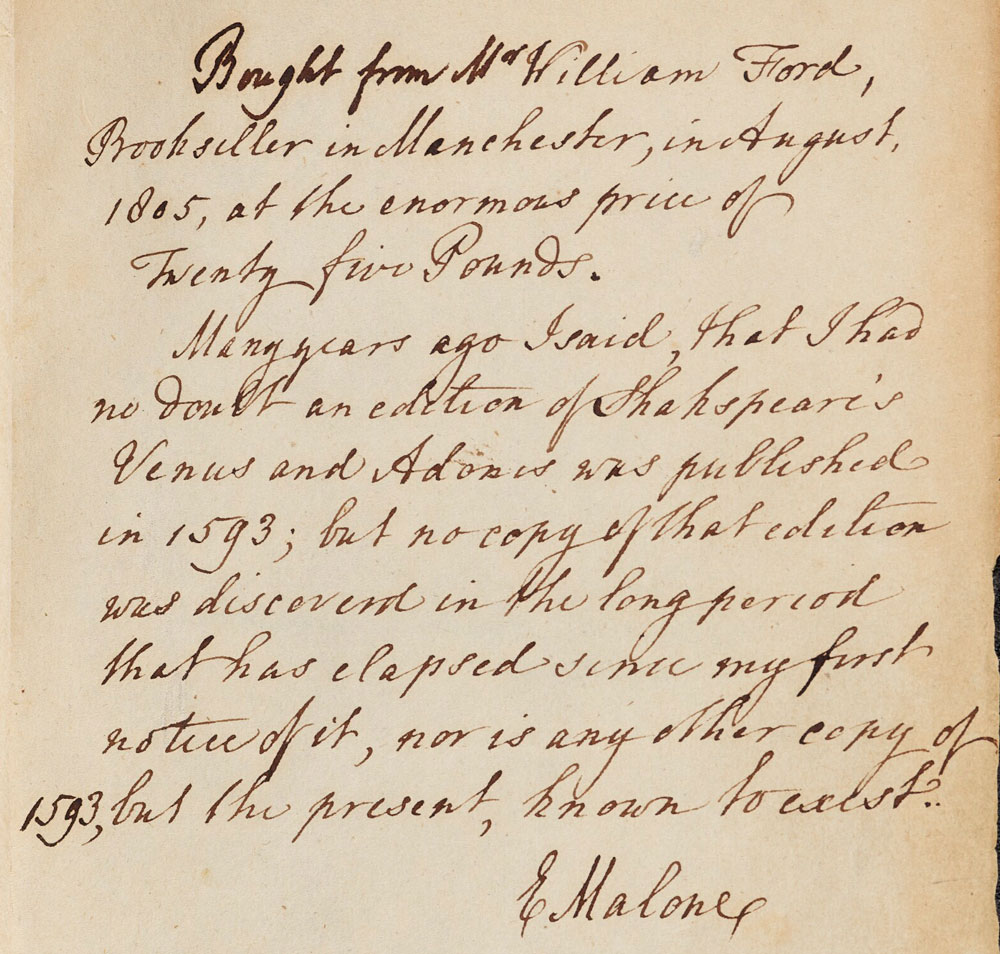
Edmond Malone’s note on the second upper flyleaf of Bodleian Library Arch. G e.31, describing its purchase in 1805.
Upon Malone’s death ten years after this purchase, his extensive library was bequeathed to his brother, Lord Sunderlin, who presented around 3,000 works from this collection to the Bodleian in 1821. Venus and Adonis and Licia had been bound together at this point for some time, possibly centuries. A potential candidate for this unification was for many years a little-known book collector who is now of significant scholarly interest: Frances Wolfreston.
Who was Frances Wolfreston?
Hailing from the English West Midlands, Wolfreston was the eldest of 22 children born to George Middlemore and his wife Frances, née Stanford.3 Frances Wolfreston is described by Paul Morgan (p. 197) as a “specimen of that rare species, the female book collector.”4 To qualify this he cites Jayne (p.46, in Morgan, p. 198) who explained that “records of the ownership of books by women are unfortunately very sparse,” and while more names can be found “in the form of printed book labels,” only approximately one percent of total labels dating from 1591 to 1677 were known to have been written by women at the time of his writing. That Wolfreston was a gentrywoman is significant, as it separates her from the aristocratic women who were much more commonly identified as book collectors.5
In the years since Frances Wolfreston’s definitive identification in 1964, the number of books to which her ownership can be attributed has gradually increased to over 200, thanks to the efforts of various scholars who have dedicated timed to collating this evidence. One of these scholars is Sarah Lindenbaum, whose website is dedicated to keeping record of every instance of Wolfreston’s ownership marks found in books across the world, with an invite to anyone with knowledge of any more examples to get in touch.6
But what, exactly, should hawk-eyed readers be looking out for if they hope to find a former piece of Wolfreston’s collection? Arch. G e.31 helpfully comes with two examples:
The clearest example is found on the titlepage (fol. A1r) of Venus and Adonis, where to the upper right of the emblem of printer Richard Field is the inscription: “Frances Wolfre[ston] hor bouk.” Similar inscriptions can be found in many books belonging to Wolfreston’s collection.
Writing in a fairly distinctive italic hand, these labels can be fairly easy to spot once one knows what to look for. However, owing to their considerable age, they may be extremely faded. A good example comes in Licia:
The end of the preface (fol. B1v) features an extremely faint inscription which shows evidence of having been erased7. The words are difficult to make out, but the telltale “hor bouk” and the style of the hand are unmistakable. For the curious, many more examples can be seen on Sarah Lindenbaum’s website linked earlier in this article.
More than a collector
From as far as can be told from the identifiable traces of her extensive book collection, over half of which addressed topics such as theology, politics, medicine, theology, and history,8 her primary interest is understood to have been in English literature and drama. Aside from the two authors mentioned above, she owned plays written by Dekker, Heywood, Marlowe, Massinger and many more.9
Beyond simply marking her ownership, Wolfreston occasionally annotated her books, revealing “a careful, active, and critical reader[…] with her own creative responses to the texts in front of her” (Roberts, p. 42).10 For example, a passage of text in Arch. G e.31’s copy of Venus and Adonis (a poem which Wolfreston may have owned as many as three versions of11) features faded lines in the margin from lines 229-240.
These faded markings, believed to have been made by Wolfreston, “suggested that [she] took an active interest in[…] the most notorious bawdy passage of Shakespeare’s poem.” Other annotations in books addressing the theme of Venus and Adonis, specifically notions of “Venus’s sexual assertiveness,” are fascinating insight into the interests of one female reader of the time.12
It is important to remember the context within which these marks of ownership and annotations were made. Roberts notes that the overall lack of annotations by women in publications of this time is in itself indicative of “the ideological pressures on and trivilialization of women’s reading.”13 Wolfreston’s books only present a limited picture, but are an invaluable shaft of light illuminating a little-understood practice. As Lindenbaum summarises, Frances Wolfreston’s mere ownership of these plays “says much about what early women could achieve in the face of limitations on education, property, and social participation.”14
Notes and References
- Blog post featured image: fol. A1r of Bodleian Library Arch G e.31, © Bodleian Libraries, University of Oxford.
- Blog post image: location as described, © Bodleian Libraries, University of Oxford.
- Hooks, A.G. (2020). Venus and Adonis, first edition. Shakespeare Documented. Retrieved September 18, 2023, from https://web.archive.org/web/20230323054855/https://shakespearedocumented.folger.edu/resource/document/venus-and-adonis-first-edition ↩︎
- Martin, P. (2006). Malone, Edmond. Oxford Dictionary of National Biography. Retrieved September 18, 2023, from https://doi.org/10.1093/ref:odnb/17896 ↩︎
- Mc Elligott, J. (2004). Wolfreston [née Middlemore], Frances. Oxford Dictionary of National Biography. Retrieved September 18, 2023, from https://doi.org/10.1093/ref:odnb/68912 ↩︎
- Morgan, P. (1989). Frances Wolfreston and ‘Hor Bouks’: A Seventeenth-Century Woman Book-Collector. The Library, 6-11(3), 197-219. https://doi.org/10.1093/library/s6-11.3.197 ↩︎
- Ibid. ↩︎
- Lindenbaum, S. (2020). About. Frances Wolfreston Hor Bouks. Retrieved September 18, 2023, from https://web.archive.org/web/20230327191658/https://franceswolfrestonhorbouks.com/ ↩︎
- University of Oxford. (2023). Licia, or Poemes of loue, : in honour of the admirable and singular vertues of his lady, to the imitation of the best Latin poets, and others. Whereunto is added the rising to the crowne of Richard the third.. Retrieved 18 September, 2023, from https://web.archive.org/web/20230918110856/https://solo.bodleian.ox.ac.uk/discovery/fulldisplay?context=L&vid=44OXF_INST:SOLO&search_scope=MyInst_and_CI&tab=Everything&docid=alma990139065700107026 ↩︎
- Roberts, S. (2008). Engendering the Female Reader: Women’s Recreational Reading of Shakespeare in Early Modern England. In H.B. Hackel & C.E. Kelly (Eds.), Reading Women (pp. 36-54). University of Pennsylvania Press. https://doi.org/10.9783/9780812205985 ↩︎
- Mc Elligott, ibid. ↩︎
- Roberts, ibid., pp. 43-44 ↩︎
- Lindenbaum, S. (2018). Written in the Margent: Frances Wolfreston Revealed. Folger Shakespeare Library. Retrieved September 18, 2023, from https://web.archive.org/web/20230703110940/https://www.folger.edu/blogs/collation/frances-wolfreston-revealed/ ↩︎
- Roberts, ibid., pp. 42-43. Roberts gives several examples of annotations in Wolfreston’s other books which suggest a considerable depth of multi-faceted interests and diverse critical reflections. ↩︎
- Roberts, ibid., p. 43 ↩︎
- Lindenbaum, ibid. ↩︎
Leave a Reply